Choosing a 'pause word' to stop an argument before it escalates
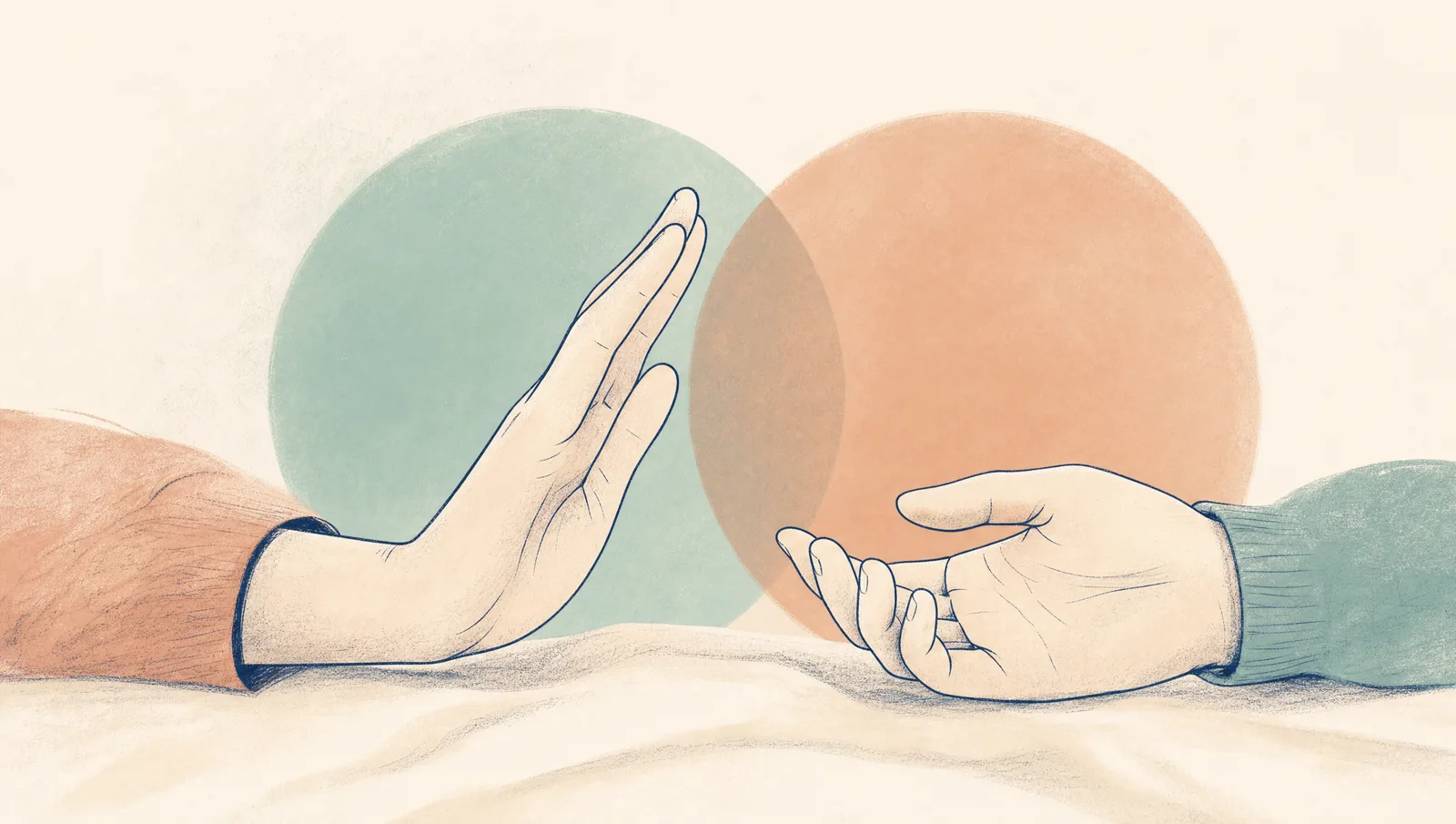
Mid-argument, saying “stop, I need a break” often backfires. Your partner doesn’t hear your need — they hear “you’re running away from me” or “you’re abandoning me in the middle of this.” The result: the request for a pause becomes its own argument.
The solution isn’t finding the right words in the heat of the moment. It’s agreeing, calmly ahead of time, on a shared signal that will always mean the same thing. That’s what a pause word is.
Why a pre-agreed signal changes everything
When an argument intensifies, the body shifts into fight-or-flight mode. Researchers at the Gottman Institute call this state flooding: physiologically overwhelmed, you stop listening and start defending. In that state, calling for a pause is like negotiating a ceasefire while shots are still being fired — your partner interprets it through the lens of the immediate threat.
A word decided in advance, in a calm moment, bypasses that negotiation entirely. There’s nothing left to debate: you’ve already agreed on what it means. In one signal, it says: “I’m overwhelmed — I’m not rejecting you, I care about us getting through this — let’s pick it back up in a little while.”
The word doesn’t replace the pause, it opens it. The full method for taking a pause (how long, how to come back) is covered in Taking a pause during an argument.
What makes a good pause word
- Neutral: definitely not a veiled dig (“calm down” doesn’t work — it’s an attack).
- Slightly playful, even a little absurd: an unexpected word often diffuses tension a notch, sometimes even draws a smile.
- Shared: you’re both in agreement on what it means. It’s not one person’s word imposed on the other.
- Easy to say when you’re tense: short, simple enough to get out when your throat is tight.
- Never a weapon: it’s not there to get the last word or slam the door (see the pitfalls below).
Examples to borrow or adapt
| Type | Example | Why it works |
|---|---|---|
| An absurd word | ”pancake”, “banana” | The incongruity breaks the escalation and signals clearly “this isn’t an attack” |
| An agreed phrase | ”should we hit pause?”, “time-out?” | Explicit, gentle, easy to recognize |
| A gesture | one hand raised slowly, an object placed on the table | Useful when words won’t come |
It doesn’t really matter which one you choose: what matters is that it belongs to both of you and that it always means the same thing.
How to choose one together, in a calm moment
Pick a quiet evening to decide, well away from any tension — never right after an argument. Agree on three things:
- The signal — the word or the gesture.
- What it means — never “you’re annoying me,” always “I’m overwhelmed and I care about us.”
- What follows — a duration (often around twenty minutes, enough time for the body to settle) and a commitment to come back and talk it through.
That third point is the most important: without a stated return, the pause word becomes disguised avoidance.
The word is just the beginning — coming back matters just as much
Once the signal has been given, the goal of the pause is to let the body settle, not to sharpen your arguments: breathe, take a walk, avoid ruminating. Then come back at the agreed time and reopen in “I” rather than “you” — a principle at the heart of nonviolent communication: speak about what you feel, without accusing.
Three pitfalls to avoid
- Using it to escape or to get the last word. The pause word protects the relationship — it doesn’t leave it.
- Not coming back. A pause without a return is just an argument left hanging — and next time, your partner won’t trust the signal anymore.
- Pulling it out too early or too often. If it’s used to dodge every difficult conversation, it loses its meaning. It’s there for the moments when you’re genuinely overwhelmed.
A pause word is a small shared agreement that turns a reactive break into a kept promise: “I’m stopping because I care about us, and I’ll be back.” Decided in a calm moment, it defuses tension before you even have to use it.
This is exactly what CoupleUp structures in its conflict mode: a pause period, then a three-step framework — feeling, need, solution — to return to calm. The app doesn’t make decisions for you or tell you what to think: you stay in control, and it simply helps you avoid falling back into the same cycle.
Want to try it together?
CoupleUp is free, hosted in Europe, ad-free.
Read next
- After an argument, who should make the first move?After a fight, each partner waits for the other to reach out. Making the first move isn't admitting you're wrong — it's choosing your relationship over being right.
- Breaking the vicious cycle of blame in your relationshipBlame, defensiveness, counter-blame, silence — and then it all starts again. How to recognise the blame loop and break it with three concrete levers.
- Taking a pause during an argument: how to do it (without dodging the issue)When an argument boils over, no one is really listening anymore. Here's how to take a real pause — the difference from walking out, the agreed 'pause word', and how to come back.